
A noisy garage door is rarely incidental; it is a warning sign.
A residential garage door is likely the largest moving object in your home. It doesn’t just move by magic; it relies on a heavy-duty system of springs, cables, and motors working in perfect sync. When one of these parts shifts, due to wear, impact, or weather, the door starts to sound different.
In the Greater Toronto Area (GTA), our equipment faces a unique challenge: Thermal Cycling. Our climate swings from -30°C in February to +30°C in July. This 60-degree variance causes steel tracks to expand and contract, thickens lubricants, and stiffens rubber seals.
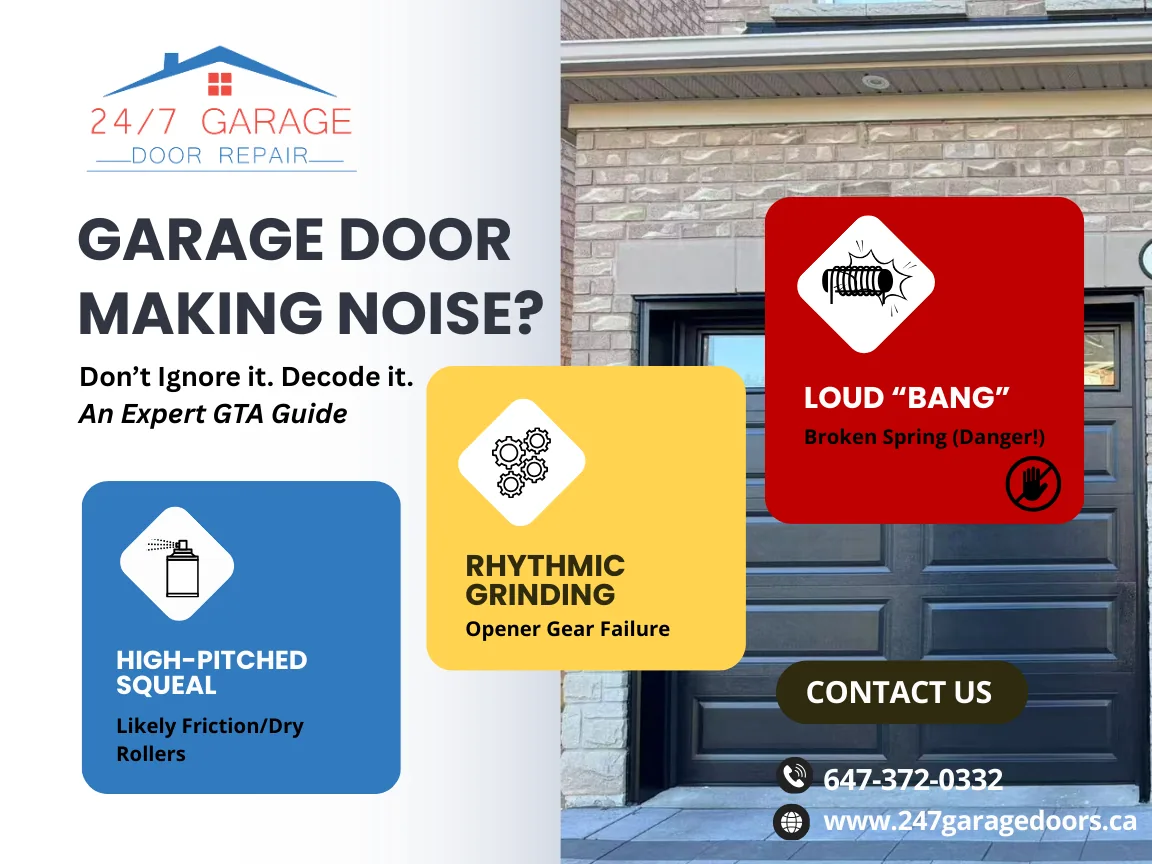
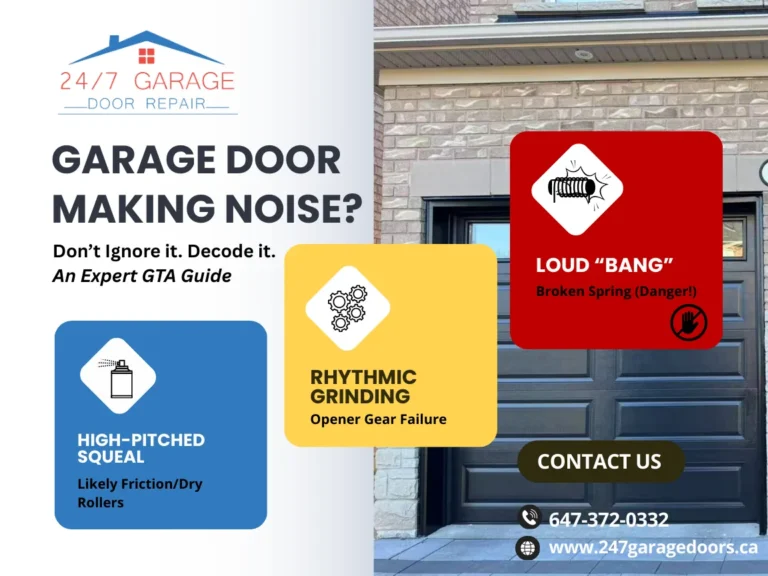
For a homeowner trying to fix a noisy garage door, distinguishing between a harmless squeak and a critical failure is essential. A high-pitched squeal might just need a little oil, but a loud “bang”(often described as a gunshot)means a dangerous spring break.
Drawing on 15 years of field experience diagnosing failures across the GTA, we have compiled this comprehensive guide. We will walk through the specific sounds your door makes, identify which part is failing, and explain exactly how to fix it.
1. The High-Pitched Squeal (Friction & Roller Failure)
The Sound: A piercing, continuous squeak or squeal that matches the speed of the door’s travel.
The Mechanics: This sound is almost invariably caused by metal-on-metal friction. In a garage door system, the rollers act as the wheels that let the door travel up the track.
- Steel Rollers: Older doors often use unsealed steel wheels. Over time, the ball bearings inside wear down, causing the wheel to drag rather than roll.
- Nylon Rollers: While generally quieter, nylon rollers can also fail. If the bearing seizes, the nylon tire will slide against the steel track, creating a “screeching” sound distinct from the metallic grind of steel rollers.
The Context: We frequently encounter this issue following a harsh winter. The salt brine tracked in by vehicles creates a corrosive mist. This airborne salt settles on the lower rollers, eating through the seals and drying out the factory grease.
Corrective Action: Many homeowners instinctively reach for general-purpose solvents (such as standard WD-40). This is a mistake. Standard WD-40 is a cleaner, not a lubricant. It strips away any remaining heavy grease, leaving the bearing dry and vulnerable to rust within weeks.
- The Solution: Apply a Lithium-based or Silicone-based spray directly to the ball bearings of the rollers and the pivot points of the hinges.
- Note: The tracks themselves should remain dry and clean. Introducing grease to the track invites debris accumulation (dust, hair, sawdust), which forms a gritty paste that slows the door down.

Service Recommendation: If you prefer a professional to handle the lubrication and safety inspection for you, learn more about our Garage Door Repair & Maintenance Services.
2. The Grinding Noise (Drive Train Failure)
The Sound: A harsh, rhythmic chewing or grinding sound, specifically coming from the ceiling-mounted motor unit (the opener).
The Mechanics: Most residential openers in our region use a nylon/plastic drive gear to turn the chain or belt. This gear is designed as a “safety fuse.” Ideally, the motor should not be lifting the dead weight of the door; the springs do the lifting. The motor simply guides the door up and down.
If the door becomes unbalanced (see Section 7), the heavy burden falls entirely on this plastic gear. The steel worm gear on the motor shaft will eventually shred the teeth off the plastic gear, resulting in that loud grinding noise.
The Context: This is common in homes with older openers (10+ years) or heavy wooden doors that have absorbed moisture. You may notice the noisy garage door getting worse over a few weeks until the door finally fails to move, even though the motor sounds like it is running.
Corrective Action: Inspection of the garage floor or the top of the motor casing will often reveal white plastic shavings (resembling snow). This confirms the gear is stripped.
- The Solution: This is a component failure that requires the replacement of the gear and sprocket assembly. However, replacing the gear without fixing the heavy door will simply destroy the new gear in months. It is advisable to have the door’s balance tested and springs adjusted simultaneously.

Service Recommendation: If you suspect your opener gear is stripped, view our Garage Door Opener Repair Services for replacement options.
3. The Low “Hum” (Capacitor or Motor Failure)
The Sound: You press the wall button. The motor emits a low-pitched electrical hum or buzz for 1-2 seconds, then clicks off. The door does not move.
The Mechanics: This is rarely a mechanical issue; it is usually an electrical failure. Inside the motor housing, there is a component called a Starting Capacitor. It acts like a battery for the motor, providing the initial jolt of power needed to get the heavy door moving from a dead stop. If the capacitor swells or leaks (often due to cold weather or power surges), it cannot provide that power. The hum you hear is the motor trying to spin but failing.
Corrective Action:
- Diagnostic Test: Pull the red emergency release cord to disconnect the door. Try running the motor again. If it still hums and doesn’t spin the chain/belt, the capacitor or logic board is dead.
- The Solution: Capacitors are inexpensive parts, but they involve high-voltage electricity. Professional replacement is recommended to ensure the correct microfarad (µF) rating is matched to your motor.
3. The Loud “Bang” (Torsion Spring Fracture)
The Sound: A sudden, violent loud noise, it is often described as a gunshot or a heavy object hitting the floor. This usually happens when the door is closed.
The Mechanics: This specific sound is the sudden release of energy from a Torsion Spring. Torsion springs are the muscle of the system. They are wound tightly to counterbalance the door’s weight. Every time the door opens and closes, the steel coil twists and untwists. This creates metal fatigue.
Springs are rated for a specific Cycle Life (commonly 10,000 cycles).
- 1 Cycle = One Open + One Close.
- If you use your door 4 times a day, 10,000 cycles lasts about 7 years.
- Once that limit is reached, the steel snaps, releasing all that stored tension in a split second.
The Context: In our region, springs are most prone to failure during extreme cold snaps (January/February). As the temperature drops, the steel becomes more brittle. If you hear this noise, you will likely find a visible gap in the spring coil above the header.

Safety Advisory: This is a critical failure. The torsion system is under extreme tension, sufficient to lift doors weighing in excess of 300 pounds. According to technical data sheets from DASMA (Door & Access Systems Manufacturers Association), torsion springs should only be adjusted by trained systems technicians due to the high risk of severe injury.
- The Solution: Do not attempt to operate the door manually or electronically. Do not attempt to move the spring. This repair requires specific winding tools and training to be performed safely.
Immediate Action: For safety reasons, this requires Professional Torsion Spring Replacement. Do not attempt a DIY repair on high-tension components.
5. Popping or Cracking (Binding & Thermal Expansion)
The Sound: As the door moves, you hear erratic “pops” or “cracks,” similar to a knuckle cracking.
The Mechanics: This sound indicates Binding: the door is getting stuck momentarily and then popping free.
- Hinge Bind: As hinges age, they can “lock up.” When the panel tries to bend around the curve of the track, the frozen hinge fights the movement until it snaps into position.
- Track Misalignment: If the vertical tracks are too tight against the door, the rollers get squeezed.
- Thermal Contraction: In winter, the vinyl weather stripping on the sides of the door can freeze to the steel panels. The popping sound is the ice seal breaking as the door lifts.
Corrective Action:
- Lubrication: First, lubricate all hinges (see Section 1).
- Check the Track: Ensure there is a small gap (about the thickness of a credit card) between the roller tire and the track edge. If the track is pinching the roller, the bolts need loosening and adjusting.
6. The “Rattle” (Vibration & Loose Hardware)
The Sound: A continuous metallic shaking or clattering that occurs throughout the door’s travel, often rattling loudest when the door starts or stops.
The Mechanics: A garage door is essentially a large moving wall that vibrates every time it moves. Over months of operation, this vibration can gradually loosen the nuts and bolts that hold the track and hinges in place.
Corrective Action: A systematic inspection of the hardware is required. Using a socket wrench (usually 7/16″ or 1/2″), check:
- The lag screws securing the track brackets to the wall.
- The fasteners holding the motor unit to the ceiling.
- The bolts on the hinges and struts.
- The Solution: Tighten these fasteners until snug. Caution: Do not over-tighten screws on the door face, as this can strip the thin sheet metal or crush the insulation foam.
Pro Tip: The Canada Safety Council explicitly recommends regular visual inspections of home mechanical systems. If any hardware appears rusted or structurally compromised, do not tighten it, replace it.
7. Diagnosing a Noisy Garage Door: The Manual Balance Test
If you have a noisy garage door but you cannot pinpoint the specific part, the issue is likely Imbalance. An unbalanced door fights the opener, causing straining sounds, grinding gears, and eventual motor burnout.
You can perform this test safely at home (provided the spring is not broken).
How to Perform the Manual Balance Test:
- Close the Door: Ensure the garage door is fully closed.
- Disconnect the Opener: Pull the red emergency release cord. This disconnects the motor, allowing you to move the door by hand.
- Lift the Door to Hip Height: Lift the door manually until it is about 3 to 4 feet off the ground (halfway up).
- Let Go: Carefully let go of the door.
The Result:
- Pass: The door should “float” in mid-air. It might drift slightly, but it should not crash down or shoot up. This means the springs are doing their job perfectly.
- Fail (Drop): If the door feels heavy and slams to the floor, your springs have lost tension. The motor is working too hard. Service is required.
- Fail (Rise): If the door shoots up into the open position, the springs are wound too tight (common after a DIY repair attempt). This is dangerous for the opener’s “down” gear.
Why This Matters: A door that fails the balance test is a ticking time bomb for your opener. No amount of lubrication will fix a balance issue. The springs must be professionally re-tensioned to restore the “floating” state.
Expert Conclusion
A quiet garage door is a well-maintained machine. By recognizing these warning sounds early, you can often address minor mechanical wear before it escalates into a catastrophic structural failure.
While simple maintenance tasks such as lubrication can be performed by the homeowner, the garage door system relies on components under extreme tension. If your diagnosis points to a spring, cable, or drive-train failure, professional intervention is not just recommended—it is a safety requirement.
Need a Professional Opinion? If you are unable to isolate the source of the noise, or if the system has failed the manual balance test, do not force the door to operate.
Book a Diagnostic Appointment to have a licensed technician inspect the system onsite. We service the entire GTA area, from Hamilton to Oshawa, ensuring your home remains secure and your door operates safely.