
The Scarborough Microclimate
In our 15 years of servicing garage doors across the Greater Toronto Area, we have learned that where you live determines how your door breaks. A torsion spring in Milton faces different challenges than one in Scarborough, and that has an effect on the garage door repair in Scarborough process.
Why? The Lake Effect.
Scarborough’s unique position along the bluffs of Lake Ontario creates a microclimate of high humidity and damp winds. For neighbourhoods south of Kingston Road, specifically Guildwood, Cliffcrest, and Rouge Hill, this environmental factor accelerates the oxidation rate of galvanized steel. We frequently encounter “premature” failures in Scarborough where hardware rated for 10 years fails sooner due to core corrosion.
If you are a homeowner in Scarborough, you are likely reading this because your door has stopped working. This guide is not a sales pitch; it is a technical breakdown of the mechanical failures specific to your area, designed to help you decide whether you need a simple adjustment or a critical component replacement.
Part 1: Diagnostic Triage (Troubleshooting Table)
Before you touch a single tool, you must identify the failure point. Overhead door systems operate under extreme tension (often in excess of 500 inch-pounds of torque). Misdiagnosing a mechanical failure as an electrical issue is the most common cause of a DIY injury.
Use this diagnostic table to correlate your door’s physical symptoms with the likely mechanical failure.
| Symptom | Visual Check | Likely Component Failure | Urgency / Action |
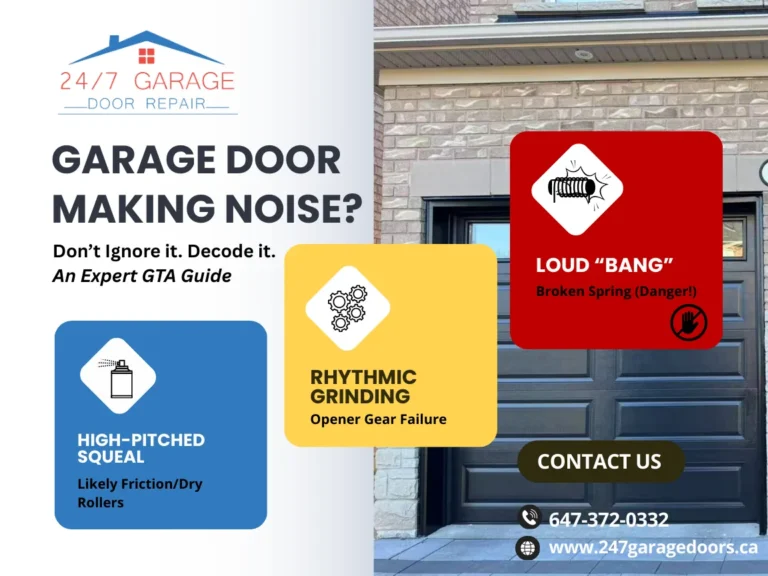
| Loud “Gunshot” Bang | Look at the spring coil above the door. Is there a 2-inch gap? | Broken Torsion Spring | CRITICAL. Do not touch. Book Emergency Spring Repair |
| Door Stuck Halfway / Crooked | Check the cable drum on the high side. Is the cable loose/spooled? | Snapped or Spooled Cable | HIGH. Stop motor immediately. Book our Cable Replacement Services |
| Motor Hums / Chain Won’t Move | Look inside the opener casing for white plastic shavings. | Stripped Main Gear | MEDIUM. Motor assembly repair needed. |
| Door Reverses & Lights Flash | Check the green/amber LEDs on the safety sensors. | Sensor Misalignment | LOW / DIY. Align sensors until lights are solid. |
| Grinding / Squealing Noise | Check rollers. Are the wheels wobbling or rusted? | Worn Nylon/Steel Rollers | LOW / DIY. Lubricate or replace rollers. |
Part 2: The “Lake Effect” on High-Tension Cables
The most frequent emergency repair we perform in Scarborough is cable failure.
Garage door cables are braided steel wires (typically 1/8″ or 3/32″ diameter) that transfer the stored energy from the torsion springs to the bottom brackets of the door. They bear the entire weight of the door.
Why it Fails: The “Slush & Steam” Effect
In standard “builder-grade” installations, these cables are made of galvanized steel. While galvanization offers some protection, it cannot withstand Scarborough’s specific winter conditions.
The problem isn’t just the air, it’s also what you drag in. When you park a car covered in winter slush, that salty road brine melts and pools at the very bottom of the door, exactly where the cable loop attaches to the bottom bracket.
Because Scarborough’s air is naturally more humid due to the lake, this salty water doesn’t evaporate quickly. It soaks into the cable core, creating a condition known as Core Rot. The inner strands rust and snap before the outer strands show damage. To the naked eye, the cable looks fine. Under load, it snaps instantly.
Our Protocol
We do not repair cables; we upgrade them.
- Material: For Scarborough homes, we recommend upgrading to 7×19 Strand Stainless Steel Cables. These have a significantly higher fatigue cycle and are impervious to salt corrosion.
- Drum Reset: When a cable snaps, the shock often spins the cable drum loose on the torsion tube. We must reset the drum index relative to the bearing plate to ensure the door lifts perfectly level.
For more on cable safety ratings, review the DASMA Technical Data Sheet on Wire Rope to understand the safety factors we are required to follow.
Part 3: Torsion Springs & The “Weight Trap”
Scarborough has a high concentration of post-war bungalows and back-splits. Because of our cold winters, the vast majority of these homes rely on Insulated Steel Doors to keep the garage warm.
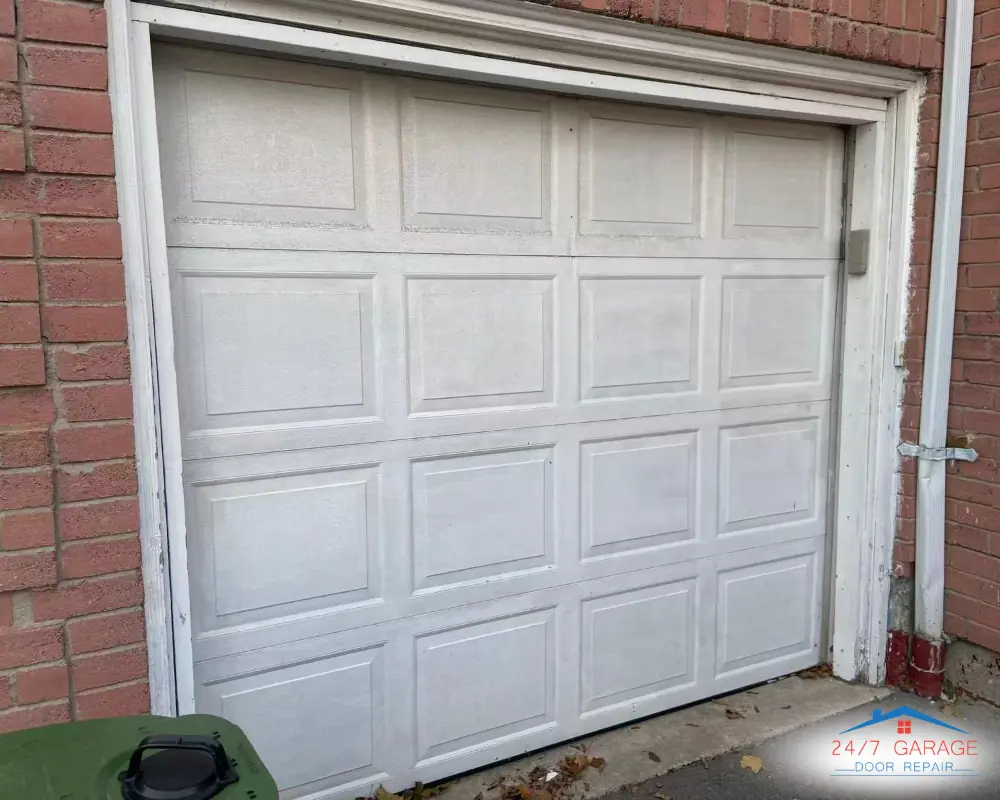
The “Generic Spring” Mistake: Since we only deal with insulated doors, we know they are heavy—typically 130–160 lbs. The problem arises when an inexperienced technician or a “lowest bidder” tries to repair one.
Many competitors carry only “standard” springs designed for cheap, hollow, non-insulated doors. When they install these weak springs on a heavy Scarborough door, the spring isn’t strong enough to lift the insulated panels. Your electric opener has to drag the extra “dead weight,” which quickly burns out the motor gears.
The Solution: High-Cycle Calibration: At 24/7 Garage Door Repair, we weigh every door before selecting a spring. We use the IPPT (Inch Pounds Per Turn) formula to ensure the spring matches the exact weight of your insulated panels.
We also recommend High-Cycle Springs (25,000+ cycles). Since insulated steel expands and contracts with Scarborough’s temperature swings, these heavy-duty springs last twice as long as standard builder-grade coils.
Learn More: Read our detailed guide on garage door spring replacements.
Part 4: Electric Opener Diagnostics (Gear & Logic Board)
We frequently service opener malfunctions in the Agincourt and Malvern areas. The most common brands we encounter are LiftMaster, Chamberlain, and older Sears Craftsman units.
1. The Stripped Gear Phenomenon
If you press your wall button and hear the motor humming, but the chain/belt does not move, you likely have a stripped sprocket and gear assembly.
- The Cause: This is almost always a symptom of a bad spring. As mentioned above, if the spring is weak, the plastic gear inside the opener takes the brunt of the weight. Eventually, the teeth shear off.
- The Repair: We replace the gear assembly using an OEM kit, but we must also re-tension the door springs. Replacing the gear without fixing the balance will result in another stripped gear within 6 months.
2. Logic Board Failure & Surge Protection
Scarborough is prone to power surges during summer thunderstorms. If your opener lights are flashing oddly, or the remotes suddenly stop working while the wall button still functions, the Logic Board (the motherboard of the unit) may be fried.
- Recommendation: If the unit is over 15 years old, replacing the board is often not cost-effective. We recommend installing a new LiftMaster Belt Drive unit with built-in surge protection and MyQ WiFi connectivity.
Part 5: Panel Replacement vs. Structural Integrity
We receive weekly inquiries from homeowners who have accidentally backed into their closed door. The question is always: “Can you just replace the panel?”
The answer depends on the structural damage behind the skin.
When Panel Replacement is Viable
If the damage is purely cosmetic (a dent in the center of the section) and the door is a standard model (like those found in newer subdivisions near Morningside), we can often source a matching section.
When Full Replacement is Required
- Bent Stiles: Look at the inside of the door. If the vertical metal supports (stiles) are bent, cracked, or separated from the skin, the panel cannot support the weight of the door when it is in the horizontal (open) position. It is a collapse risk.
- Interlock Failure: Garage door panels use a tongue-and-groove system to seal against wind. If the impact deformed the top or bottom edge of the panel, the new panel will not seal correctly against the old ones, leading to heat loss.
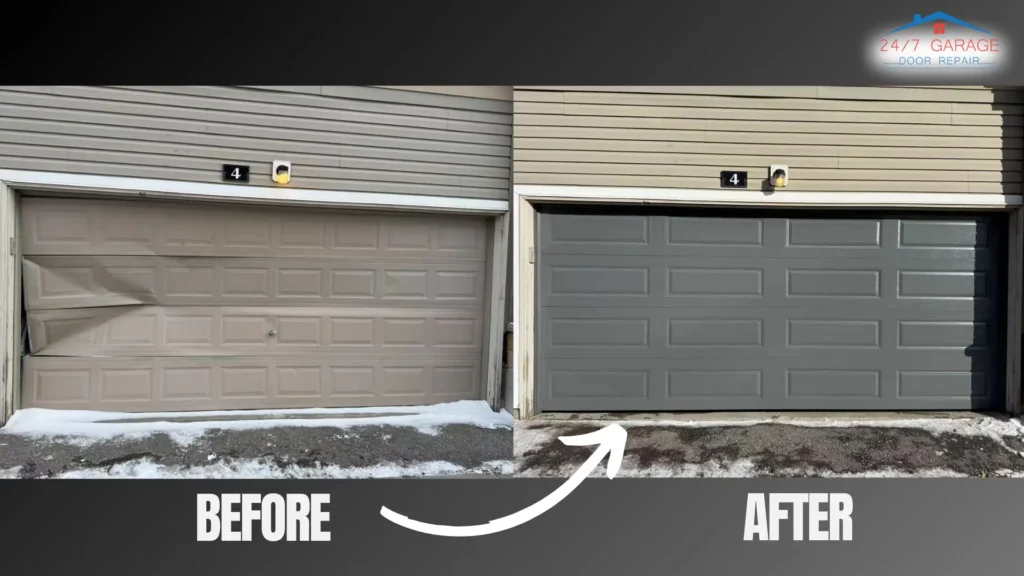
If your door is older than 15 years, finding a panel that matches the faded colour of your existing door is nearly impossible. In this case, we recommend a full New Garage Door Installation to improve insulation and curb appeal.
Part 6: Preventative Maintenance (DIY Protocol)
You can extend the life of your hardware by performing maintenance twice a year: once in November (before the freeze) and once in April (after the thaw).
Required Tools:
- Silicone-based lubricant (Do NOT use WD-40 or grease).
- 7/16” Wrench.
- A clean rag.
Step-by-Step Maintenance:
- Lubricate Rollers: Spray the ball bearings inside the rollers. If you have nylon rollers, do not spray the nylon wheels, only the steel center bearing.
- Tighten Hardware: Vibration loosens bolts over time. Use your wrench to snug the lag bolts that hold the tracks to the wall and the hinges to the door.
- Check Balance: Pull the red emergency release cord to disconnect the opener. Lift the door halfway (waist height) and let go.
- If it stays: Your springs are balanced.
- If it falls: Your springs are weak.
- If it shoots up: Your springs are too hot.
For a visual guide on safety checks, refer to the LiftMaster Safety Checklist.
Part 7: Why Local Dispatch Matters
When a spring breaks, your car is trapped. You cannot wait for a service truck dispatching from Hamilton or Burlington.
At 24/7 Garage Door Repair, we structure our logistics around local service zones. We keep technicians active on major Scarborough arteries (Lawrence Ave, Kingston Rd, Sheppard Ave) to ensure we can respond to calls in the east end without crossing the city.
Our Trucks Carry:
- High-Cycle Torsion Springs: Various gauges to match older wood doors and newer steel doors.
- Stainless Steel Cables: To combat the humid Scarborough environment.
- Emergency Clamps: To secure off-track doors safely before repair.
Ensuring Safe Operation
Garage doors are the largest and heaviest moving objects in your home. While tasks like lubrication and sensor alignment are safe for homeowners, repairs involving springs, cables, and track alignment require specific winding bars and training to be performed safely.
If you are experiencing any of the issues outlined in this guide, especially snapped cables or broken springs, do not attempt to force the door open.
Need a Diagnostic in Scarborough? Our team is ready to help. Book Your Service Call Today
Disclaimer: This guide is for informational purposes only. Garage door springs and cables are under extreme tension. Always consult a certified technician for internal repairs. For reference see DASMA Safety Guidelines.